
Why Aging Clothes Are Beautiful Clothes
by IOAN Staff
At IOAN, our mission is to create garments steeped in heritage, tradition and ethics. This means adopting methods and materials that buck trends in fast fashion, instead valuing qualities like construction quality and timelessness.
One of the coolest parts of our work is collaborating with local artisans to understand how the products we make will wear over time. Our clothing is built to last, to age, and ultimately, to mirror the change and resiliency of the human bodies they cover. While the bulk of clothing worldwide is created to be worn and disposed of in a single season, we’ve spent years refining practices that result in items which should be used for years.
Historically, clothing production at small, local scales prized garments that could be worn for as long as possible. As a result, the way that high-quality clothing ages and changes over time has a rich history of cultural appreciation. Today we wanted to highlight a few popular examples of how we celebrate the aging of garments, as opposed to looking for replacements at the first sign of wear!
Denim patina
One of the most well-known and widely-celebrated instances of garment aging comes from jeans. Originally, jeans were created for working. Levi Strauss’ 1873 patent for a riveted cotton pant includes tons of design details intended to create rugged, long lasting garments that could hold up to the working conditions of the American West. Miners, railroad workers, cowboys and more needed clothing that would support them across a variety of harsh environments.
These roots are why even today, the aesthetics of well-worn jeans are prized above the look of a brand new pair. We all know the feeling of coming across a pair of jeans in the thrift store which are perfectly broken in— there’s something special about it. As jeans are used, they are meant to soften, to fade and to adapt to the body they are protecting. Jeans develop unique patterns of wear depending on how they are used, and what conditions they are exposed to.
In this way, worn jeans are not seen as a mark of a defective product, but just the opposite. Jeans where the indigo has faded and the knees have become flexible show that the garment was built to last, and has lived a life of use. A well-loved pair of jeans reflects and supports the life of its wearer, celebrating the idea that clothing should be built in a way that frames aging and uniqueness as a positive.
Indian kantha
Kantha is primarily an Indian sewing technique where multiple layers of fabric are woven together using running and cross stitching to create durable, beautiful, and culturally significant items. Most often kantha uses cotton, linen, and silk, though you can find garments made from all sorts of fabric types using this technique.
Aesthetically, kantha is gorgeous to look at because of the intricate stitching patterns and the layering of many different pieces of fabrics. What’s even cooler is that kantha is often employed as a way to reuse, upcycle and combine materials from garments or fabrics that can no longer be worn. Families in India often have kantha cloth quilts made from old clothing worn by different generations of members. Saris, dresses, pants and any other piece of clothing can be combined with this technique to create something new, made with literal layers of history
Like quilts, kantha bedding is often handed down as family heirloom, developing unique fading and wear marks reflecting a family’s story. Repairs and additions are not seen as detractors to the item, but a mark of a new chapter! When something becomes worn, the way a family chooses to repair it adds to the richness of meaning; a grandmother might add her own signature motif or message to her grandchild, for example. In this way, the wear and history of kantha cloth items are directly linked to their aesthetics, and celebrated for their longevity and aging.
Visible mending and workwear
Long before industrialization and fast fashion, fabrics were expensive and time-consuming to produce. As a result, working people often invested heavily in garment repair, patching holes, closing tears and otherwise doing whatever was necessary to keep their apparel in wearable shape. Especially for workers who required speciality clothing for their occupations, replacing expensive garments simply wasn’t an option every time something sustained a rip or got stained.
Visible mending is so cool because it demonstrates technical proficiency, individuality and utility all in one. Techniques like sashiko embroidery from Japan are a good example of how repair can add aesthetic value to pieces. The same can be said for darning techniques often found on chore coats from rural France.
Nowadays there are entire stores and even conferences around the culture of vintage repaired garments. With workwear in particular, collectors value items that have unique fading, repair elements, and otherwise notable alterations that suggest a life of use. Imperfections and character add value to the pieces, rather than detract.
Natural dye fading
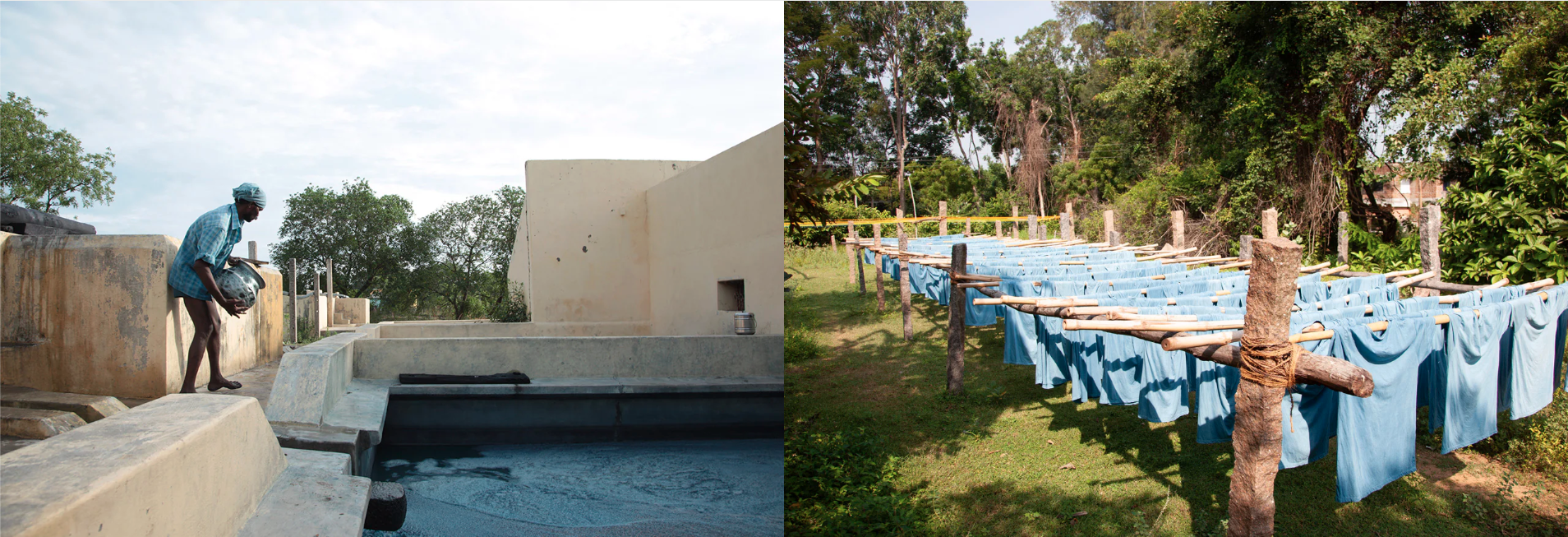
At IOAN we work with expert natural dye artisans who use techniques honed over thousands of years to achieve rich garment coloration without toxic additives. Using substances like indigo, shellac beetle resin, iron, and more, our teams develop colors designed to change subtly over time, creating uniqueness across each and every garment that is specific to its wearer.
All sorts of variables affect how natural dye changes over time. Exposure to sun, wash and dry factors, and even the humidity and water composition of different areas all affect how colors ebb and flow between garments. The same shirt worn and cared for by two different people in different areas are sure to age differently. We find this concept inherently beautiful.
While huge fashion companies and wholesalers pride themselves on releasing waves and waves of cheap, uniform designs every season, our focus on high-quality garments that are meant to age with their owners is best reflected in how our dyes become more beautiful over time. Whether on a t-shirt, chore coat, or pants, we view the variability of natural dye fading as a signature feature for our customers to own and embrace.
To learn more about our process, check out our collection of natural dye products here.